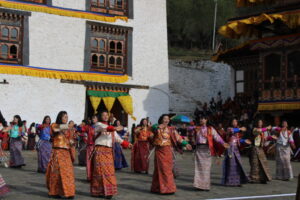
 The elements I enjoyed the most in my study abroad program were all the pre-planned trips and cohort activities that took us to various parts of the country. My cohort was able to experience the culture, people, and landscape of Bhutan, as well as learn from experts who implement critical environmental initiatives and lead important research.
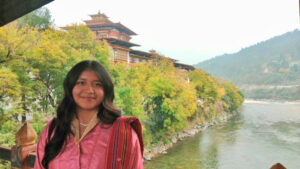
I was able to borrow my sister’s camera to document my semester abroad. I want to share my favorite photos; some I took, others are from my friends on the program! One of my friends took this photo of me in front of the Punakha Dzong (fortress) the day we went to the Punakha Tshechu (festival). This was one of the first times we got to wear our national Bhutanese dress, the kira for women, and gho for men. This visit was a stop on our way to The Royal University of Bhutan’s College of Natural Resources in Lobesa, Punakha. We got to meet university students and took classes taught by professors there!
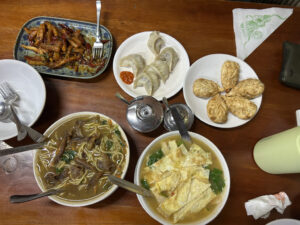
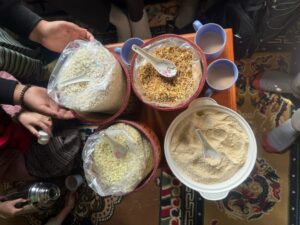
Somehow, I didn’t take many photos of all the great food I had. I was probably busy trying it all that my camera definitely did not eat first! The photo above (left) is of a meal I had with friends at a restaurant called Zombala in Thimphu, the capital of Bhutan. We had steamed and fried momos (dumplings), crispy chili potatoes — a must every time we ate out— and two noodle dishes, including veggie thukpa. My friend took the image on the right; it’s one of my favorite snacks I was offered each time we were invited into someone’s home— puffed rice and milk tea. My absolute favorite was a combination of two types of puffed rice, butter, and sugar you scooped up in your hand, along with buckwheat flour you could add to your cup of milk tea. A common beverage I unfortunately did not enjoy quite as much is suja, butter tea.
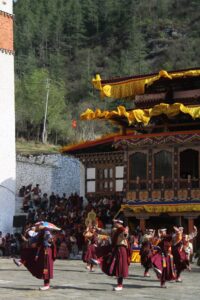 The following images are from the Paro Tshechu (festival), in the Paro Valley where our center was based and where I spent much of my time. These are performances we watched on the last day of the festival. These festivals occur in every district of Bhutan over the year. The Paro festival brought people from all over the valley and other districts as well. We wore our national dress and walked through the crowds listening to the music, prayers, and watched many performances.
The day prior, we had woken up before sunrise to be at the festival for the unfurling of the thongdrel, the largest form of religious image. While at the festival, we heard the news that the king of Bhutan might make an appearance! We watched as the king arrived dressed in his gho and draped in the yellow kabney, a ceremonial sash in the color reserved for the king and the chief abbot, and hiking boots. On his way into the festival, the king stopped in front of our group and exchanged a few words with us. I think we were all starstruck after that!